
Background and Customer Needs
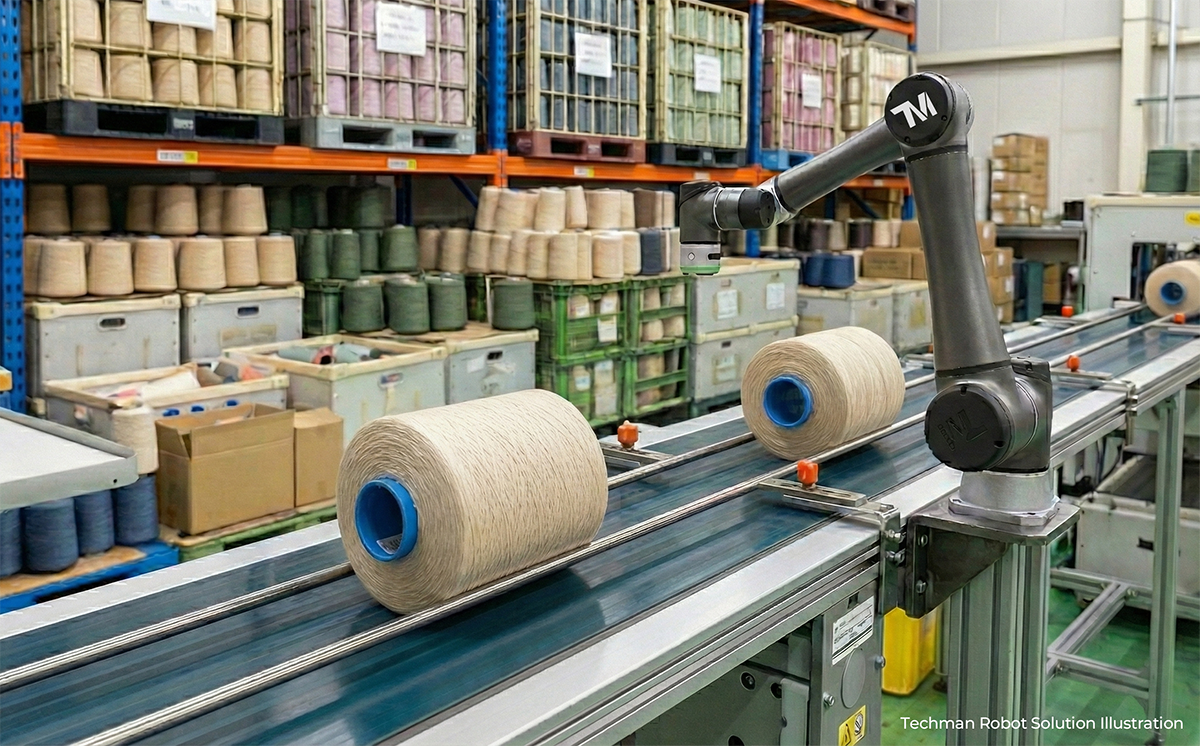
A leading manufacturer in the thread roll industry, recognized for its diverse applications in industrial, sports, and fishing sectors, has initiated a strategic project to enhance the quality control of its airbag yarn production. The primary goal is to upgrade their inspection processes to meet the rigorous safety standards required for automotive components.
Challenges
Inspecting thread rolls presents unique visual complexities that make traditional rules-based vision difficult:
- Diverse Defect Types: The morphology of the “fuzz” defects varies significantly, requiring a flexible detection system capable of learning multiple defect forms.
- High Visual Noise: The texture of the wound yarn creates a noisy background. Without advanced processing, standard vision systems easily confuse the normal yarn winding with actual defects.
- Depth of Field and Focus: Because the camera inspects the side of a cylindrical roll, defects located at the curvature’s edge often appear blurry or out of focus, leading to potential missed detections.
- Ambiguous Labeling: There were discrepancies between human annotators and AI predictions regarding the precise area of a defect, making it difficult to establish a “perfect” ground truth.
Solution
To address these challenges, a Proof of Concept was established using Techman Robot’s AI capabilities integrated with high-end vision hardware.
The inspection setup included:
- Vision Hardware: A Basler acA2500-14gm camera paired with an OPTART 25mm fixed focus lens and a CCS LDR2-50SW2-JD light source.
- Configuration: The system was set up with an object distance of 30cm, capturing images of the sides of the yarn rolls.
- Mechanism Strategy: To solve the focus issues caused by the roll’s curvature, the evaluation concluded that a rotating mechanism is necessary to bring defects into the focal plane for accurate detection.
AI Model Training
The project utilized TM AI+ (Version 2.22.1700) to create a robust defect detection model.
- Dataset Composition: The model was trained on 98 images to capture the wide variety of defect shapes, with 17 images reserved for testing.
- Labeling: The team annotated defects (NG) across the dataset. The initial training involved 59 labeled instances.
- Continuous Improvement: Due to the high variance in defect appearance, the validation loss was difficult to minimize initially. The team identified “Auto AI Training” as a crucial feature to automatically collect negative samples and strengthen the model against false positives.
Results & Benefits
The evaluation in the TM laboratory environment demonstrated the feasibility of the AI solution:
- Effective Detection: The TM AI system successfully detected defects in the controlled lab environment.
- Addressed False Positives: Despite the noisy texture of the yarn, the AI was able to distinguish between the yarn winding and actual fuzz defects.
- Clarified Mechanical Requirements: The testing revealed that static imaging leads to missed detections due to blur (3 misses out of 59 labels in one test set). The analysis confirmed that implementing a rotating mechanism to ensure defects are focused would resolve these misses.
- Scalability via Auto AI: To handle the “infinite” variety of fuzz shapes, the team recommended implementing Auto AI Training to continuously refine the model and reduce ambiguity between human and AI judgment.
Conclusion
This evaluation for customers proves that AI inspection can overcome the difficulties of detecting subtle defects on complex textures like airbag yarn. While environmental factors like lighting and focus are critical, the combination of TM AI+ Trainer and proper mechanical design ensures a reliable automated quality control process. By adopting Auto AI Training, the system is future-proofed to adapt to new defect variations, ensuring long-term consistency and quality.